

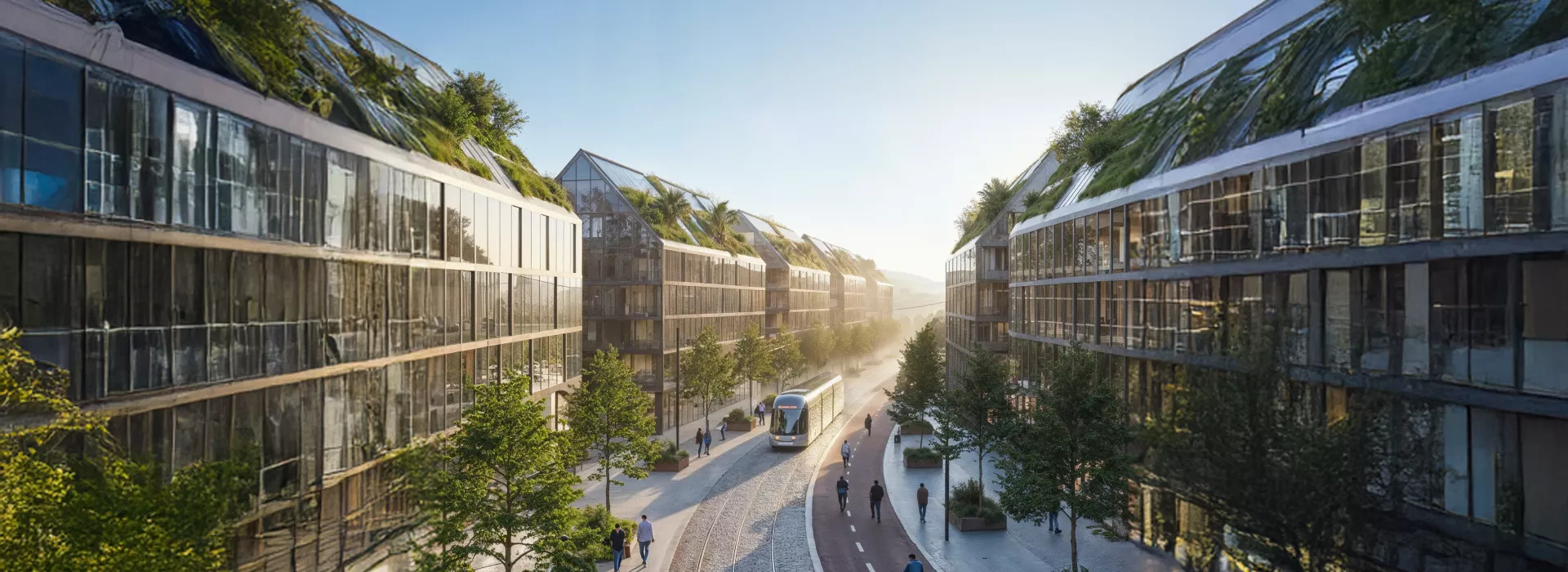
AGC Glass Europe is committed to reaching AGC Group’s objectives and, to that end, has set out a roadmap to achieve net-zero glass production by 2050.
To achieve this ambitious and necessary goal, every part of the value chain must be taken into consideration.
This includes decarbonising our glass production processes and eliminating all CO2 emissions from the supply chain upstream of our processes, as well as other indirect emissions.
As one of the market leaders in flat glass, AGC Glass Europe is committed to playing a leading role in developing new glass products that deliver better environmental performance throughout their lifetime, up to and including end-of-life recycling AGC’s innovative products dovetail seamlessly with the company’s goal of achieving a more sustainable future and, accordingly, play a key role by improving energy efficiency and helping reduce CO2 emissions.
Since the launch of its Low-Carbon Glass range in 2022, AGC has been offering its customers glass products, which – from the extraction of raw materials to final installation – generate less CO2 than our standard products.
To produce Low-Carbon Glass, AGC took a holistic approach that focuses on five main areas: the sustainable sourcing of raw materials; the use of high-efficiency melting furnaces; the increased use of cullet (recycled glass); the use of low-carbon energy; and the optimisation of transport, both for finishing treatments (between Group sites) and for finished products.
Low-Carbon Glass range
AGC’s Low-Carbon Glass is a key milestone in AGC’s roadmap to carbon neutrality.
AGC Low-Carbon Glass boasts an improved GWP value of 4.8 kg CO₂eq./m2 for 4 mm thickness, which is more than 50% lower than the European average. With a recycled content of more than 60%, it is the ideal choice for those committed to environmental responsibility. Available without volume limitations, this glass already meets current and future legislation regarding CO2 emissions and circularity.
Low-Carbon Glass products deliver the same aesthetics, quality and technical performance as traditional AGC float glass products. They can be laminated or coated with solar control or thermal insulation coatings and can be processed into double and triple glazing units.
Use of high-efficiency melting furnaces
Three of AGC’s most efficient furnaces – located at our Moustier, Seingbouse and Osterweddingen plants – have already incorporated new technologies, such as electro-boosting, that partially replace natural gas with electricity for melting sand.
Passing an electric current between electrodes generates heat that is transferred to the molten glass twice as efficiently.
The Volta R&D Project is another breakthrough pilot project that aims to significantly reduce CO₂ emissions and support the transition to sustainable flat glass production.
AGC and Saint-Gobain are collaborating on a pilot flat glass line to significantly reduce CO2 emissions. AGC’s Barevka plant in the Czech Republic has been upgraded and is now 50% electrified and 50% fired by a combination of oxygen and gas, providing a more sustainable alternative to natural gas-fired furnaces.
This hybrid furnace is expected to reduce the pilot site’s Scope 1 and 3 emissions by 75% and will serve as a proof-of-concept for large float glass furnaces. The project is funded by the European Union's Innovation Fund.
AGC and Saint-Gobain are collaborating on a pilot flat glass line to significantly reduce CO2 emissions. AGC’s Barevka plant in the Czech Republic has been upgraded and is now 50% electrified and 50% fired by a combination of oxygen and gas, providing a more sustainable alternative to natural gas-fired furnaces.
This hybrid furnace is expected to reduce the pilot site’s Scope 1 and 3 emissions by 75% and will serve as a proof-of-concept for large float glass furnaces. The project is funded by the European Union's Innovation Fund.
Increased use of recycled glass
Another high-impact driver in our holistic approach is the increased use of recycled material in our glass production processes.
As glass is endlessly recyclable, AGC is making major efforts to increase the cullet content used in the glass production process by leveraging multiple recycling streams, either from AGC subsidiaries or from demolition projects (end-of-life glazing from commercial projects or residential buildings).
To this end, AGC launched Recycle Glass, a service for collecting flat glass waste. AGC works with partners specialising in dismantling facades and removing glazing, which is then processed into high-quality cullet for recycling, the aim being to maximise remelting in our flat glass furnaces. Using more glass cullet reduces the consumption of raw materials and energy, resulting in lower CO2 emissions and the production of glass with less embodied carbon, such as our Low-Carbon Glass range.
In addition to our goal of ensuring more sustainable glass production, using AGC products will also help minimise CO2 emissions from buildings and homes, thereby contributing to a healthier environment.
Our innovative products help save energy, reduce CO2 emissions, generate renewable energy and improve indoor air quality. By integrating advanced technologies and sustainable practices, we aim to create a positive impact on both the environment and society.
Energy-saving glass solutions


Solar control glass is ideal for solutions delivering the right combination of solar protection and thermal insulation. Solar control coatings filter the sunlight, preventing excess heat from building up inside the building while letting in plenty of daylight. They are superb for saving energy, since they prevent overheating, which in turn leads to lower air conditioning costs, lower energy consumption and lower CO2 emissions.
AGC has developed an extensive solar control range with its Energy, ipasol, Stopray, Stopsol and Sunergy brands.
Low-emissivity glass lets the sun’s rays pass through the glass yet reflects any indoor heat back into the room so that it does not escape – forming a shield against the cold. Generally used in double or triple glazing, this type of glass saves energy thanks to its excellent thermal insulation performance. At the same time, its superb light transmission maximises the amount of natural daylight in any building. AGC boasts a wide range of super-insulating coated glass products, unified under the iplus and Planibel (Pyrolitic low-E) brands.
Vacuum glazing is one of AGC’s latest innovations. Fineo, the company’s flagship product in this niche, deploys pioneering vacuum-insulation technology to deliver exceptional thermal control in a slimline glass product. It delivers the same energy performance as a triple glazing unit yet a pane of Fineo is four to five times thinner than conventional products, and a mere one third of the weight. With its thin profile it can integrate seamlessly into renovation projects or newbuilds alike.
Energy-generating glass solutions
Not only can glass control energy, but it can also play a role in generating electricity. Our solar mirrors for solar farms are at the forefront of renewable energy generation. These innovative products are designed to maximise the efficiency of solar farms and integrate seamlessly into buildings, providing a sustainable source of energy. By harnessing the power of the sun, these technologies help reduce reliance on fossil fuels and contribute to a greener future.
Preserving Indoor Air Quality
On average, we spend 90% of our time indoors, which means indoor air quality is an important health concern. Everyone's health can be affected by indoor air quality issues. Indoor air pollutants include the chemicals released by the building itself and by the materials used in it. Such chemicals include volatile organic compounds (VOCs), which can have adverse health effects in the short and long term. AGC's Mirox 4Green+, its first lead-free mirror featuring a water-based coating, was launched in response to these concerns. This product delivers the same high-quality performance as Mirox MNGE, but stands out for its use of lead-free, water-based paints and its high opacity, making it ideal for backlit applications. Mirox 4Green+ complies with the ROHS Directive.

In addition to this innovation, AGC Glass Europe has tested its interior decorative painted glass products Lacobel, Matelac and Mirox according to ISO 16000-9 in order to evaluate their potential VOC emissions. These products score in the top classes under French legislation on indoor pollutants emissions.
AGC’s standard Planibel float glass now boasts an improved GWP value of 9.8 kg CO₂eq./m2 for 4 mm thickness. This is 5% lower than the European average and 12% lower than some of the least sustainable glass available in Europe. With a recycled content of 11.2% it is an excellent choice for construction industry stakeholders who want to act responsibly in the face of environmental challenges.
These new values are valid for the entire Planibel range in all countries, including clear, extra-clear and coloured float glass.
Ensuring transparency and credibility in our sustainability efforts is essential. To support our customers in making informed choices and to demonstrate our dedication to environmentally responsible glass production, AGC Glass Europe adheres to internationally recognised certifications and labels. These certifications assess our products' environmental impact throughout their lifecycle and validate our continuous progress towards more sustainable solutions.
Environmental Product Declaration (EPD)
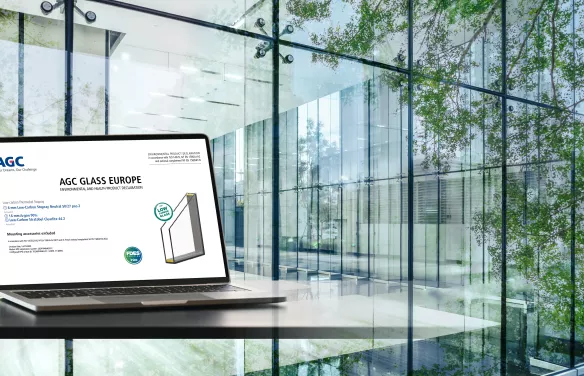
Environmental Product Declarations (EPDs) provide a transparent, standardised assessment of a product’s environmental impact throughout its lifecycle — from raw material extraction to end-of-life recycling. AGC Glass Europe has gradually expanded its portfolio of EPDs over the years, with third-party verification now ensuring the highest level of reliability.
To facilitate sustainable decision-making in the construction industry, AGC recently launched its Environmental Product Declaration (EPD) Generator, which is fully integrated in the Glass Configurator. This powerful tool covers both the Standard and Low-Carbon versions of seven product families, in other words a total of 14 product families for which a reference EPD has been published in INIES, the French national reference database for environmental and health data on construction products and equipment.
Thanks to this innovative tool, AGC is now capable of automatically generating verified EPDs for a large proportion of its product portfolio.
Cradle to Cradle Certified® Products (C2C)
The Cradle to Cradle (C2C) programme assesses product sustainability based on five key criteria: material health, circularity, climate protection, water stewardship and social fairness. AGC was the first European glassmaker to achieve this certification in 2010 for its float glass and magnetron-coated glass. Since then, the certified portfolio has continuously expanded to include seven product ranges, covering decorative glass (painted glass, acid-etched glass, lead-free mirrors), decorative and solar mirrors, laminated glass, insulating glass, and fire-resistant glass.
LEED® Certification
LEED® – Leadership in Energy and Environmental Design™ – is a sustainable building certification system developed by the US Green Building Council (USGBC). AGC works with experts to assess how its glass solutions contribute to energy efficiency and environmental performance, and thus influence four of the nine LEED categories.
BREEAM® Certification
BREEAM® – Building Research Establishment Environmental Assessment Method – is a label evaluating buildings' environmental impact. AGC collaborates with BREEAM® experts to demonstrate how its glazing enhances energy performance, indoor air quality and innovation, thus directly influencing four of the ten assessment categories.