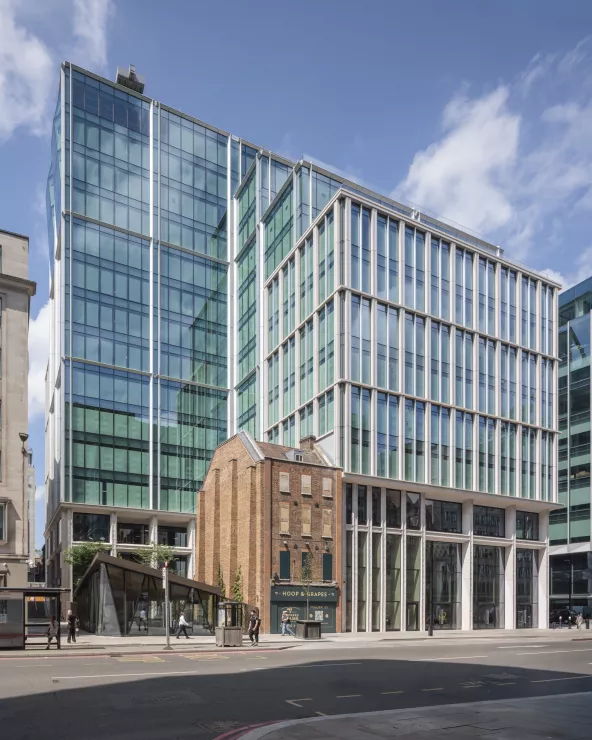
The "Stonecutter Court" office building in London, completed in 2025, was designed by TP Bennett with a focus on comfort, user-oriented design and sustainability. The use of modern building technology, solar panels and a high-performance solar control insulating glass façade enables particularly low CO2 emissions – the aim is to achieve BREEAM Excellent and WELL Gold certification. Focchi was responsible for the design, production and installation of the special façade, including a diamond grid façade system that combines modular and prefabricated elements. AGC Interpane Architectural Glass supplied non-standard glazing for the entire façade: partly triangular and trapezoidal ‘ipasol neutral 70/37’ and ‘Stopray Vision-62’ solar control insulating glass, often with stepped edge units due to the special geometries, on tempered and non-tempered low- and mid-iron base glass and mostly constructed as laminated safety glass on both sides.
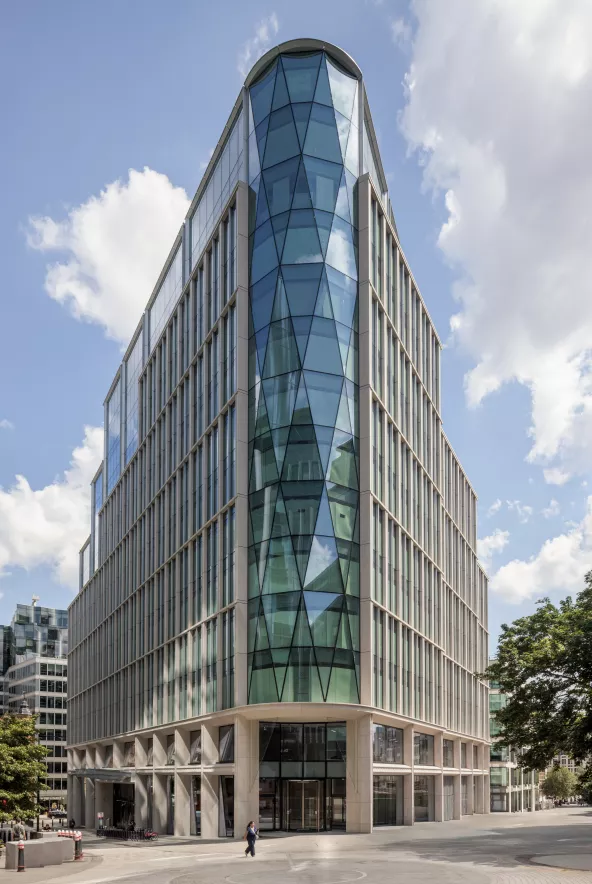
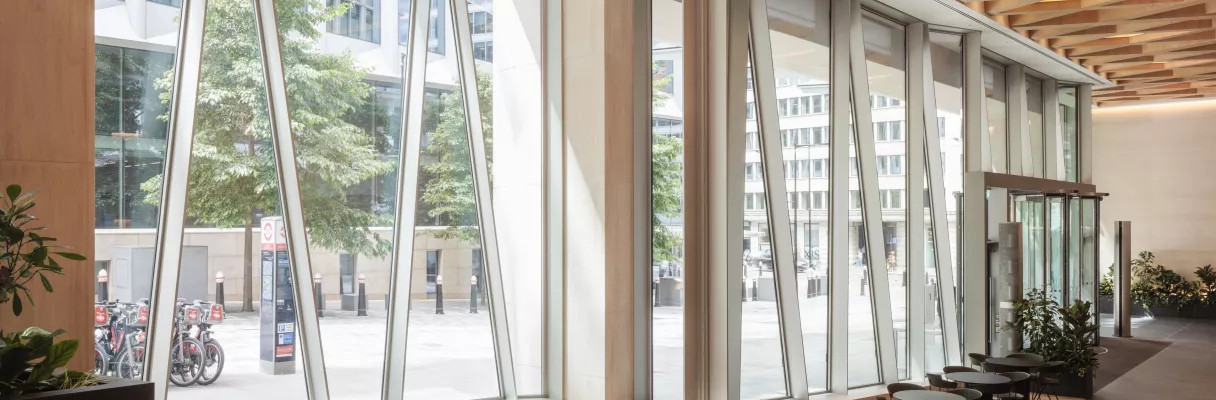
The 13-storey Class A office building was developed by CO-RE in collaboration with Allianz Real Estate and Ivanhoé Cambridge. Located next to the listed Hoop & Grapes pub in the Fleet Street conservation area and within the protected sightlines of St Paul's Cathedral, the façades were designed to respect and enhance the cityscape. Focchi worked closely with the architects at TP Bennett, Mace Ltd., façade consultants FMDC and the project-experienced insulating glass specialists at AGC Interpane Architectural Glass from the early design phase through to completion. The façades of Stonecutter Court are divided into different types: perhaps the most striking is the tall diamond-shaped façade at the tapered front of the building, with its triangular and trapezoidal elements and structurally connected double glazing. The vertical and horizontal alignment of the ‘diamonds’ is repeated every four floors. Within each section, each element is individually dimensioned so that interlocking triangles and trapezoids alternate. To enhance the three-dimensional appearance, the elements deviate from the vertical by approximately 2° and have been alternately shifted inwards and outwards.
AGC Interpane Architectural Glass supplied customised trapezoidal and triangular Stopray Vision-62 solar control glazing in various dimensions, with partially stepped edge units and finely ground edges – the inner panes are slightly smaller in size to accommodate the three-dimensional structure. Depending on the position, both tempered and non-tempered mid-iron base glass and combinations are used in the ‘glass packages’, which have been constructed into laminated safety glass on the inside and outside. In addition to their high aesthetic appeal, the glazing offers daylight transmission of 58 per cent, a Ug value of 1.0 W/(m²K) and excellent sun protection with a g value of at least 30 per cent. The main façade consists of structurally glazed units, glass fibre reinforced concrete, aluminium slats and balustrades. Here too, AGC Interpane used Stopray Vision-62 solar control glazing as laminated safety insulating glass units in various dimensions, framed in aluminium frames with special profiles for thermal and sound insulation and excellent solar control. On the lower floors, GRP beams and columns with a slim, braced substructure ensure maximum stability, low weight and high material efficiency. Where the façade protrudes above the surrounding buildings and adapts to the modern architecture of the city, it is formed from so-called ‘letterboxes’ made of oxidised aluminium. Focchi developed micro-adjustment systems for both systems, which ensure perfect alignment of all opaque elements across the entire façade.
The entire ground floor of the main façade consists of custom-made T-shaped aluminium profiles with diamond-shaped double glazing. For maximum daylight transmission, a particularly neutral aesthetic and excellent sun protection, AGC Interpane Architectural Glass supplied ‘ipasol neutral 70/37’ insulating glass, which achieves excellent daylight transmission of LT = 72% on low-iron base glass, effective solar protection of g = 37% and a Ug value of 1.0 W/(m2K). Here too, AGC Interpane Architectural Glass designed all trapezoidal laminated safety insulating glass with slightly stepped edges to suit the special geometry of the façade. Each section consists of a vertically inclined bay window that slopes outwards below the parapet and recedes upwards. The entire façade is cut off at the base and follows the sloping pavement, so that the ipasol neutral solar control glazing reaches an oversize of 8.1 metres at its lowest point.
All base glass products in the ipasol and Stopray families have been awarded the bronze-level Cradle to Cradle sustainability certification and are also available as low-carbon variants with corresponding EPDs as part of the new CO2-reduced production process of AGC Glass Europe.
Photos: ©Dirk Lindner