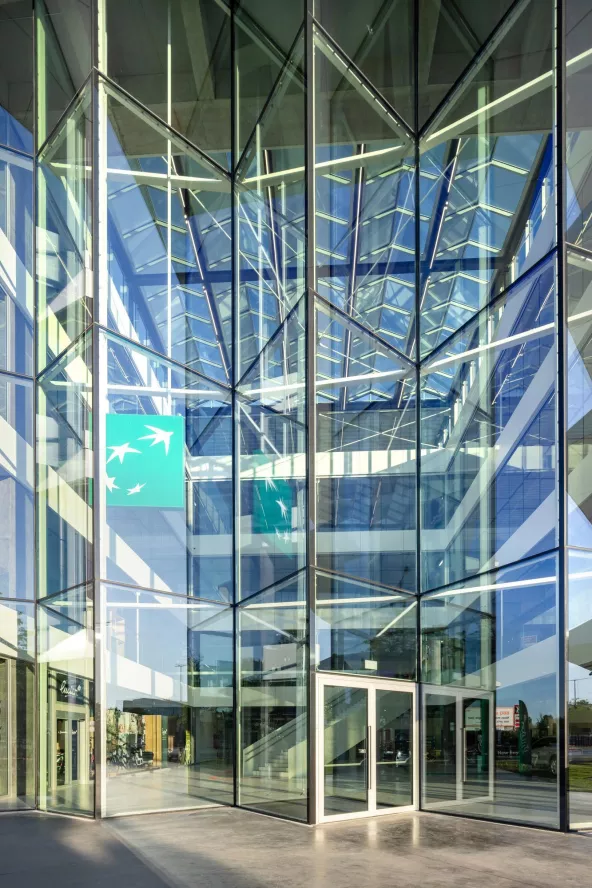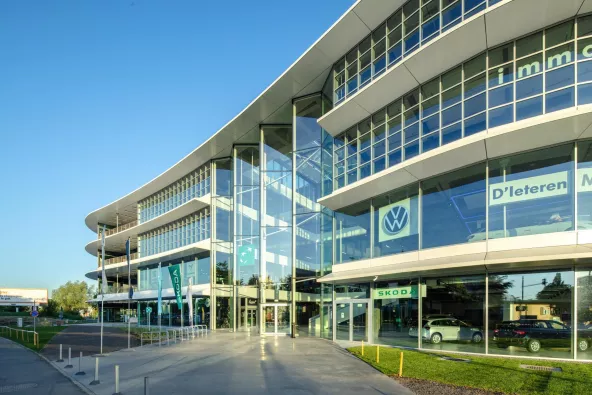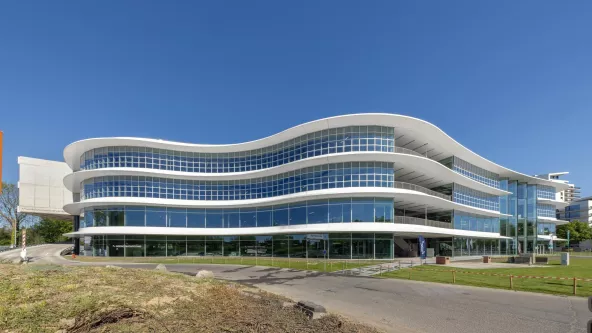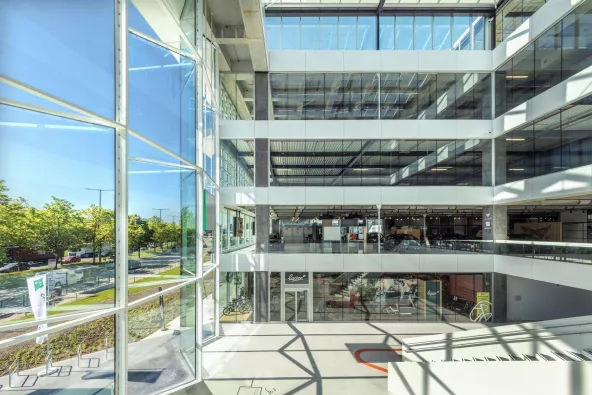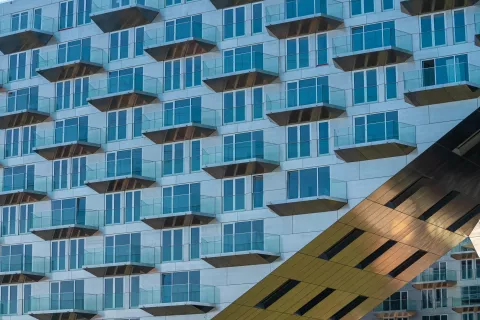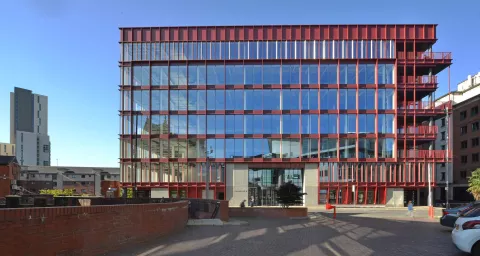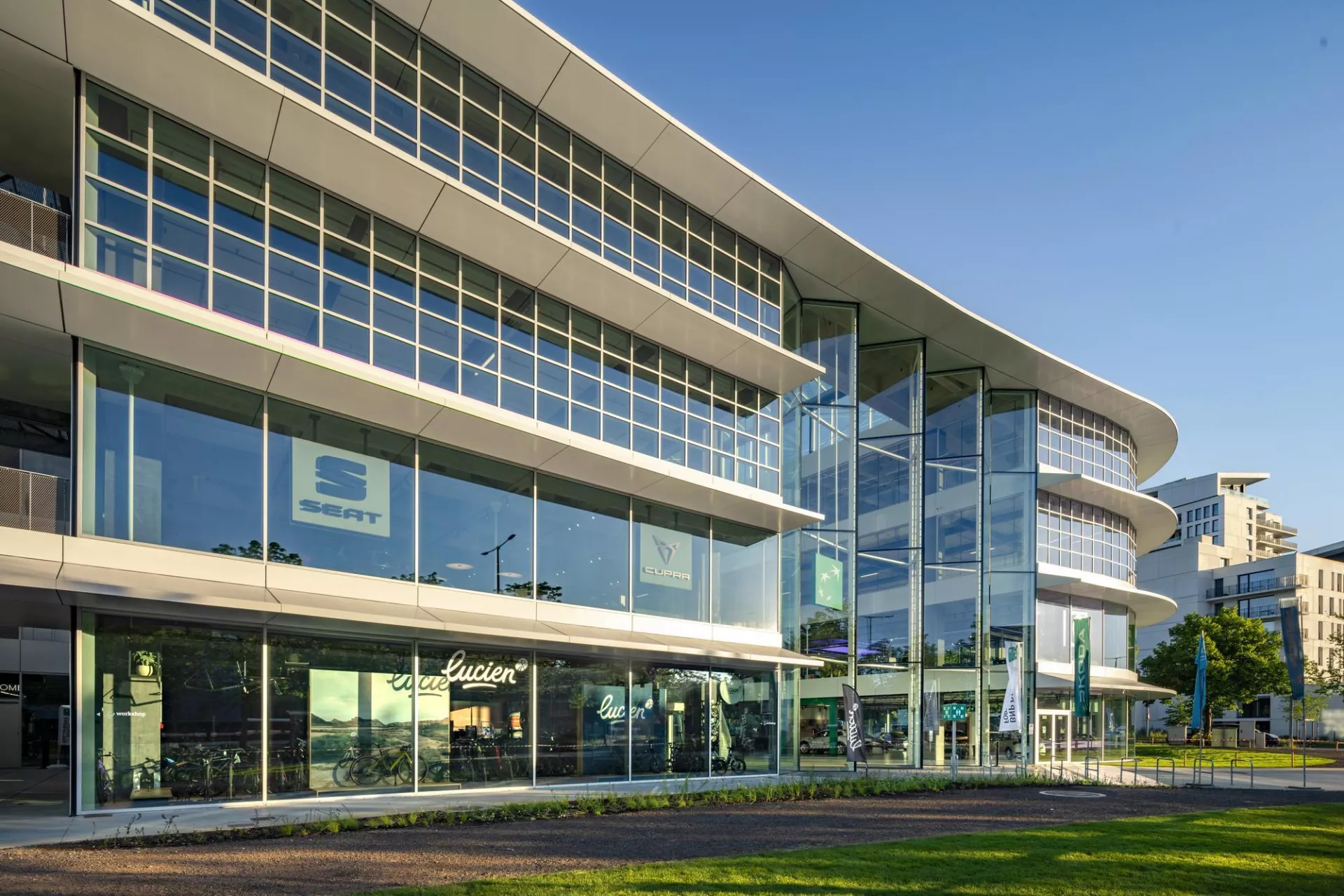

Jules Verne's famous catchphrase Mobilis in Mobili – which roughly translates as 'moving within the movable' or 'changing within the changeable' – applies perfectly to Mobilis, a sustainable project located in the Anderlecht district of Brussels in which mobility and flexibility are key. This energy-neutral building has been awarded the highest level of certification for circularity and sustainable use – BREEAM Outstanding – thanks in part to its accordion facade featuring AGC Glass Europe's Low Carbon Energy 72/38 glass.
Commissioned by leading Belgian automotive distributor and dealer D'Ieteren, the project has seen the 10,000 m2 site transformed, in the space of just a few years, into a bold, mixed-use urban complex with 3.5 times the original surface area. Not only is it home to D’Ieteren Group’s Volkswagen, Škoda and SEAT/CUPRA garage, but it can also accommodate a diverse range of urban industry, manufacturing activities and commercial functions.
Design and construction
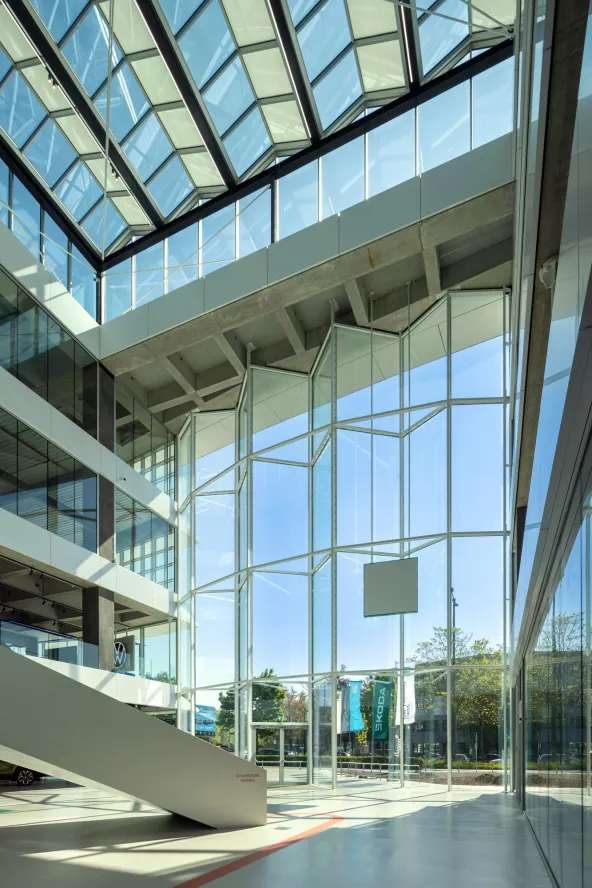
In November 2018, D'Ieteren Immo launched an architectural competition in cooperation with the Brussels government architect. The winning team, consisting of XDGA, Boydens and UTIL, successfully translated the client's lofty ambitions into an innovative yet practical design. Thanks to some outside-the-box thinking, the spaces within the building can be easily adapted at any time to meet different needs, making it fully aligned with the client's long-term vision. D'Ieteren wanted the Mobilis building to be suitable for a wide range of activities, not just commercial purposes. So while the Volkswagen, Škoda and SEAT showrooms occupy an entire floor, the design can also accommodate offices, co-working spaces, sports and fitness facilities, a museum, restaurants and cafés, as well as urban agriculture on the roof.
This ambitious brief is reflected in the engineering. The building has four stories. Floors 2 and 4 were built using the concrete waffle slab system, while floors 1 and 3 consist of a lighter steel structure, suspended from the floor above using tie rods. A custom-designed, adjustable system makes the infrastructure flexible so that the spaces are almost infinitely adaptable. For the same reason, each storey is 7 metres high, allowing false ceilings to be added if the future use doesn't require the full height.
BREEAM and Be Circular
D'Ieteren also specified climate- and energy-neutral techniques to make the Mobilis project completely future-proof. Geothermal energy harnesses the constant temperature of the earth for heating and cooling, allowing the building's temperature to be managed efficiently regardless of the use and specific needs of each space. In addition, features such as solar panels, natural ventilation and rainwater storage mean that, less than a year after it opened, Mobilis is already being dubbed 'the building of the future'.
The project's vision and execution have earned Mobilis a BREEAM Outstanding rating, as well as accolades such as the Be Circular award. The Brussels-Capital Region named it one of the winners of this prestigious competition at the end of 2020, four years before its completion. Besides the fact that the existing building was dismantled in line with circular principles, what the jury appreciated most was the construction design, with its customised structure built to last 100 years and its removable platforms.
Low Carbon Glass facade
The glass facade – the glazing units for which were supplied by Sint-Niklaas, Belgium-based glazing manufacturer Polypane – is also a winner, with Low Carbon Energy 72/38 glass structurally bonded to stainless steel profiles to create an accordion effect. This is a defining feature of the building, with the only visible components being the slender, vertical profiles of the underlying metal structure. Managing Director Franky Symoens is proud of the result. "It's glass for all four seasons, combining insulation, transparency and solar protection. Structurally, the accordion facade is very interesting: we bonded the glass to a stainless steel profile and mounted it on the steel structure. To ensure a seamless fit, we had to use a step system, alternating the inner and outer panes with an overhang or contrasting, shorter step. The result is virtually profileless. We structurally bonded the glass in the accordion facade to the frames provided by facade builder Groven+, which then installed them."
AGC produces its Low Carbon Energy 72/38 glass using a mix of sustainable measures, including sustainable sourcing of raw materials, deployment of efficient melting furnaces and greater use of cullet (recycled glass). In other words, the project combines circularity and mobility. D'Ieteren's ambition was for Mobilis to be a link between the city, local residents and the economy – and that has been achieved, resulting in a multifunctional, flexible and sustainable building.