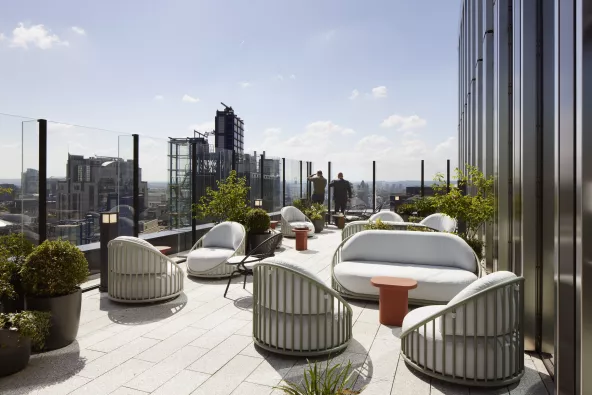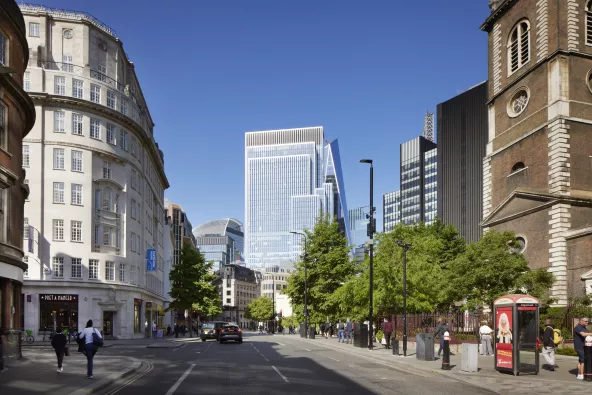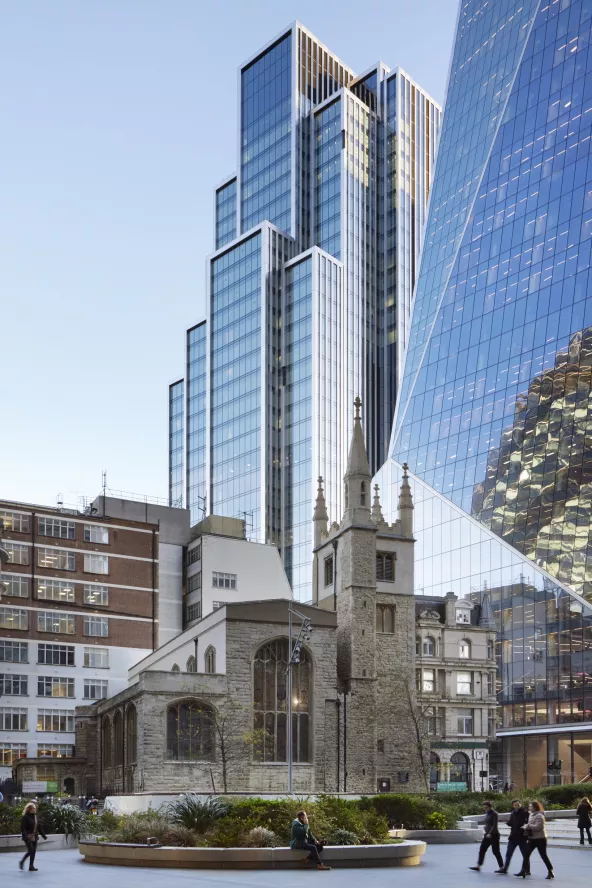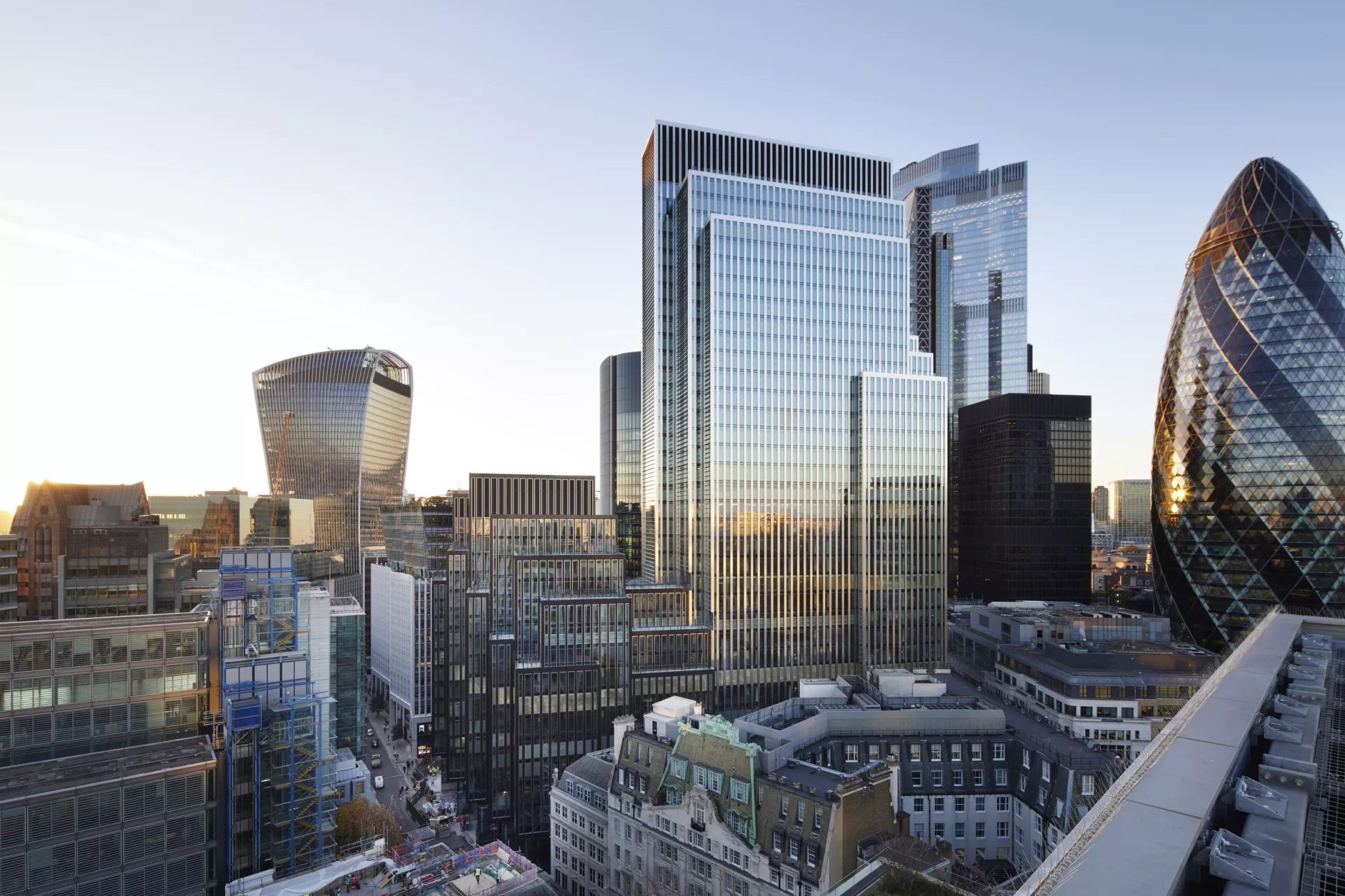

40 Leadenhall Street is one of the largest building projects ever completed in the historic City of London: 85,000 m² of floor space for 10,000 building users. The elegant design by Make Architects, featuring two towers on a shared podium, is inspired by American skyscrapers of the early 20th century and is arranged in vertical ‘slices’ that slope down from 34 storeys at the end of Leadenhall Street to 7 storeys towards the Thames, with 17 outdoor terraces at different heights.
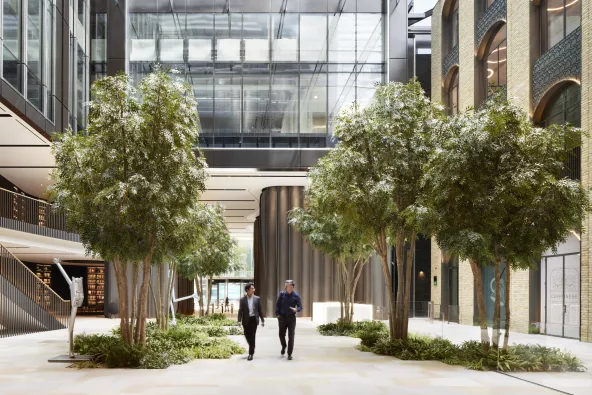
In addition to office space, the project houses restaurants, bars, a fitness centre, a wellness suite and clubhouse, event rooms and a two-storey lobby with a green atrium. At ground level, the building recedes from the site boundaries, creating new public spaces with generous pedestrian zones. Due to stringent conservation requirements, it had to be embedded above and below ground in historic structures that have been reused for the project. For example, the restaurant on the ground floor is located in the Grade II listed Billiter Building dating from the 19th century, which was partially integrated into 40 Leadenhall.
High-precision unitised facade created by Focchi
The outer shell is a ‘unitised’ facade produced by facade maker Focchi. It consists of large-format elements, i.e. ‘units’, which were completely pre-assembled in the factory, with stainless steel frame profiles, structurally silicone-bonded double insulating glazing, seals and fittings. The finished modules were then delivered to the construction site and connected to the building there, element by element, like Lego bricks. The advantage of this construction method is that the modules can be assembled independently of the interior fittings, speeding up progress during the construction phase. Producing the units in the factory under controlled conditions also resulted in high quality and better sealing, enabling the modules to be precisely integrated into the large and complex building regardless of the weather. AGC supplied more than 30,000 m² of customised, double silver-coated Stopray Vision-60 solar control insulating glass, which protects the building from overheating in summer and at the same time transmits plenty of daylight.
The double glazing is constructed as laminated safety glass on both sides. The outer unit (VSG 66.4) consists of two partially toughened 6-mm-thick panes with four PVB interlayers (1.52 mm), with edge printing in position 2 (RAL 7021), Stopray Vision-60 in position 4 and with finely polished edges. AGC Interpane Stainless Steel Spacers in black and black silicone (DS 3363) were installed in the 16-mm-wide gap. The inside (VSG 55.4) was constructed from two non-prestressed 5-mm-thick panes with four PVB interlayers (1.52 mm), also with polished edges. Thanks to the highly selective Stopray Vision 60 coating, the glazing boasts a high daylight transmission of 58% despite its laminated safety glass structure on both sides, high solar control with a g-value of 32% and, since it is filled with argon, excellent thermal insulation of Ug = 1.0 W/(m2K).
Outstanding environmental certifications
The building is not only environmentally friendly in its design, but also in its use. It is one of the first buildings in the UK to receive NABERS 5-Star certification, a standard for energy efficiency that assesses the actual energy requirements in use in addition to the technology used. The building exceeds the UK government's net zero performance targets and produces around 40% less carbon emissions than building regulations allow. It has also been awarded the BREEAM Excellent building environmental certificate and the EPC A rating (Energy Performance Certificate). The project also aims to obtain WELL Platinum for health and user comfort, WiredScore Platinum for its smart infrastructure and SmartScore (SMART) focusing on digitally driven smart building control.
Pictures: ©Jack Hobhouse