

I love to be on the spot to find new architectural projects that could feature our great portfolio of products and solutions. Working in close collaboration with architects and engineers is a great opportunity and finding the right solutions for their specific needs is very satisfying. Every project brings new and exciting challenges to crack, which makes my job so diverse and enjoyable. Your Dreams, Our Challenge – that’s our motto.
Short biography
Bhadresh Parbhoo is IBP Manager Belux at AGC Glass Europe. With more than 25 years of experience in the glass industry, he has become a valuable business partner for architects, supporting them in large national and international building projects. He holds an MSc Construction Engineer, Building & Civil Construction Engineering from ECAM Brussels Engineering School in Belgium.
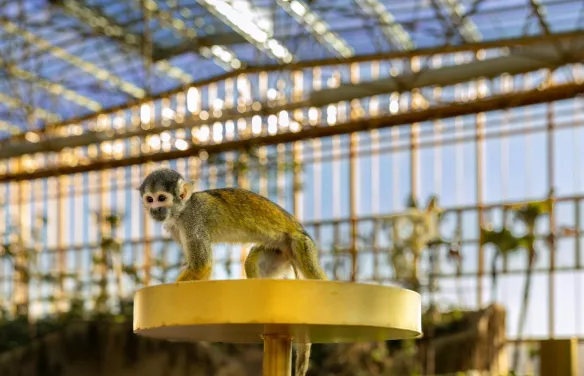
Edenya was unlike any conventional façade or roof glazing project because the glass had to create the right environment for three very different types of occupants at the same time: plants, animals and people. Normally, glazing is designed primarily around human comfort and energy performance. Here, the ecosystem itself became part of the design brief.
The project involved a flat glass roof of more than 40,000 m² covering what is today the world’s largest tropical greenhouse. The challenge was to create a highly transparent roof structure capable of controlling heat and solar gain while still allowing enough UV radiation to pass through for the fauna and flora to thrive naturally.
That combination of requirements made it a truly exceptional project for AGC.
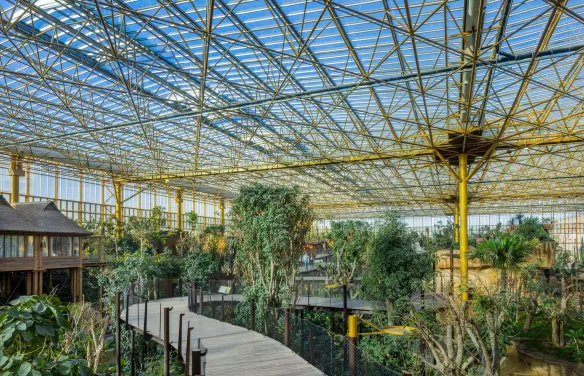
Usually, solar-control coatings are designed to block a large part of solar radiation, including UV rays, in order to improve indoor comfort and reduce overheating. But in Edenya, we had the opposite challenge: we needed to reduce solar heat while still transmitting part of the UV spectrum.
Plants and animals require UV light for natural biological processes, while visitors need protection from excessive heat and sunlight. Finding the right balance between these apparently contradictory requirements required us to rethink the traditional approach to solar-control glazing.
This is where AGC’s coating expertise and R&D capabilities became essential.
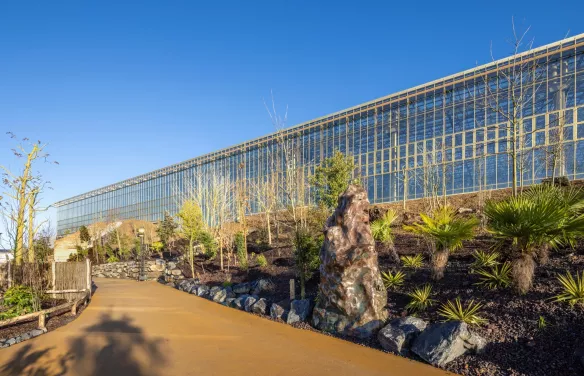
We worked very closely with the project stakeholders from the earliest stages of development, particularly architect Pascal De Beck and engineer Thierry Gérard. Based on their vision, we collaborated internally with AGC’s R&D specialists to develop a completely tailor-made glazing concept.
The key element was a custom-made solar-control coating developed specifically for Edenya. Unlike conventional coatings, this one was engineered to allow approximately 40% of UV radiation to pass through while still blocking most of the solar heat.
Developing this coating required extensive laboratory testing because we had to redesign the coating composition around UV permeability rather than purely aesthetics or thermal performance. It was a very intensive and innovative process.
The project required a true multifunctional glazing solution. In addition to the custom coating, we also integrated a UV-transmitting PVB interlayer in the laminated glass.
At the same time, the roof had to deliver strong thermal insulation in order to limit heat losses inside such a large tropical environment. The glazing achieved a Ug-value of 1.0 W/m²K, which was an important performance target for the project.
Part of the roof glazing was also heat-treated to make it walkable for maintenance purposes. So the final solution combined UV transmission, solar control, insulation, safety and durability in one glazing system.
Yes, absolutely. We often develop custom coatings for architectural projects, but these are generally driven by visual appearance or façade aesthetics.
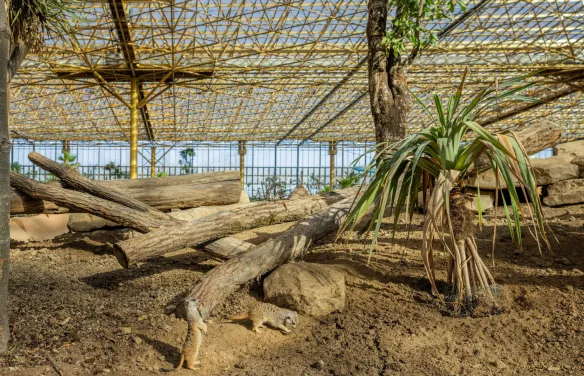
For Edenya, the starting point was completely different. The coating had to respond to biological and environmental requirements. We had to rethink how the coating interacts with UV radiation while still maintaining solar-control performance.
That made the project particularly exciting from an innovation standpoint because it pushed us beyond the traditional boundaries of façade glazing.
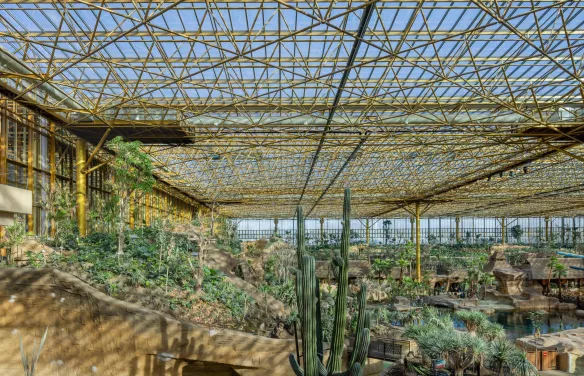
Definitely. Pairi Daiza strongly appreciated the fact that this was a truly Belgian glazing solution involving several AGC sites and subsidiaries.
The sand came from Mol, the glass was produced in Moustier, the coating was applied in Lodelinsart and the final assembly took place in Kortrijk. Multiple AGC entities contributed to the project, including AGC Mirodan Bouwglas and AGC Mirox.
It demonstrates the strength of local expertise and integrated know-how across the entire glass value chain.
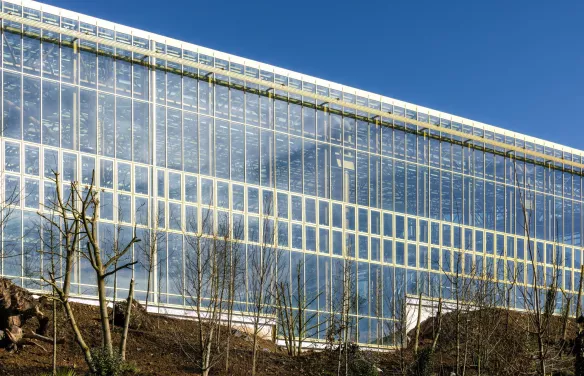
Absolutely. Since the completion of Edenya, we have already received interest from several countries for similar glazing concepts using UV-transmitting solar-control coatings.
The project demonstrates that glass can do much more than simply enclose a building. It can actively contribute to creating controlled ecosystems and new types of immersive architectural environments.
As architecture increasingly focuses on sustainability, wellbeing and biophilic design, I believe projects like Edenya open very interesting perspectives for the future.